The week the calendar ate
Friday evening. You were in back-to-back meetings all week, you answered everything, you were reliable and responsive and available. And if someone asked what moved forward, you’d struggle to name one thing.
The unsettling part is that it didn’t feel like a wasted week while you were in it. Every hour had a reason. That’s exactly what makes this pattern so durable.
A calendar fills itself
Left alone, a calendar tends toward full. Every meeting is individually justifiable, nobody schedules one out of malice, and any free block reads as availability to the next person who needs half an hour.
What no one is watching is the aggregate. There’s no alarm that fires when the fourth recurring meeting lands on your only clear afternoon. Each acceptance is small; the sum is your entire week.
Focused work needs an unglamorous ingredient — an uninterrupted stretch — and unbroken stretches are precisely what a full calendar has none of. Six free half-hours between meetings are not three hours of work. They’re six warm-ups.
You can’t fix a pattern you can’t see
Here’s the trap. A busy week doesn’t announce itself. It feels productive, right up until you try to say what came of it.
Which is why the only reliable way out is to look back on purpose — not to grade yourself, just to see the shape of what happened. Once a week, five minutes, one honest question: what did this week actually move?
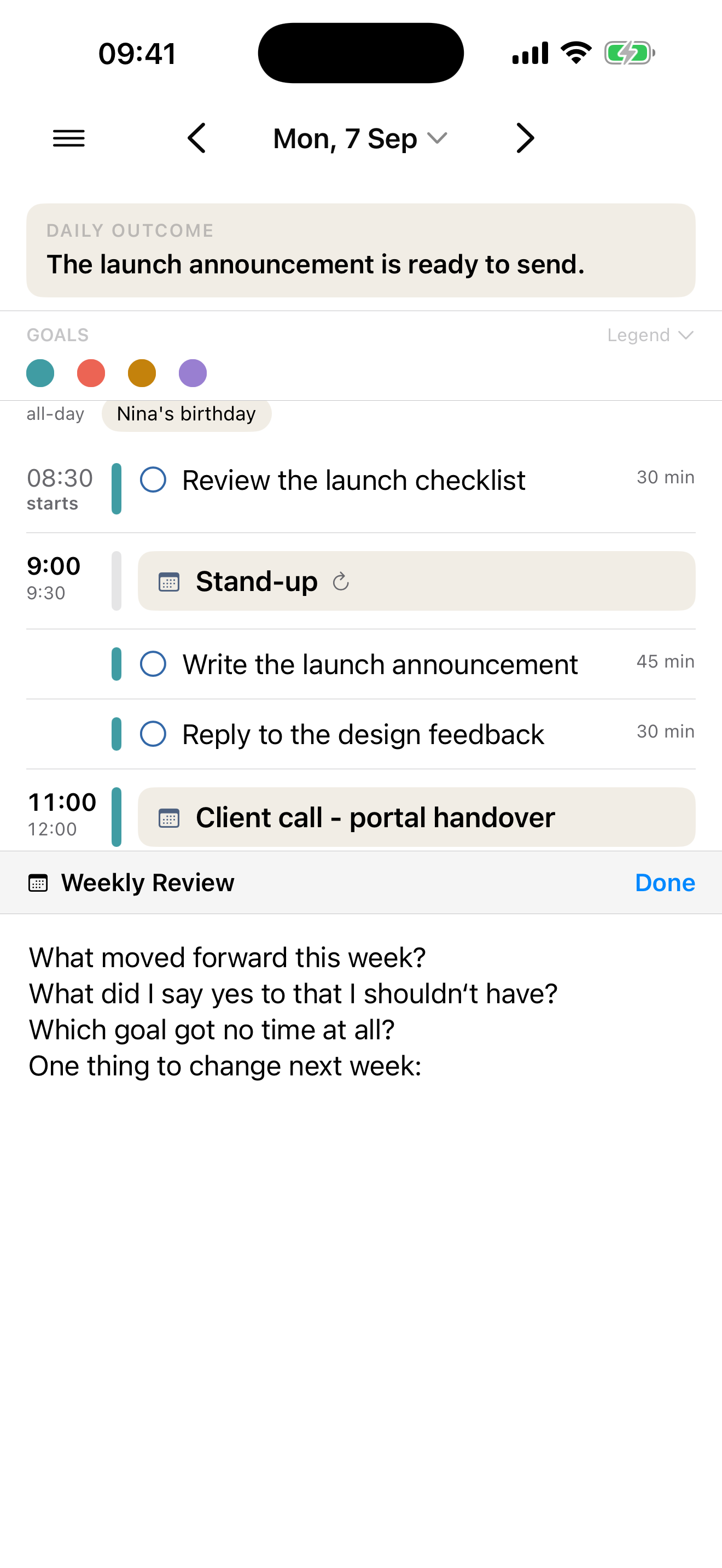
Colour helps more than you’d expect. When the work that serves your goals is visibly marked, a week where nothing was marked is unmissable — and unarguable. It’s not a feeling any more, it’s just what’s there.
Write it down, briefly
A look-back you only think about evaporates. A written one accumulates.
It doesn’t need to be much. Three prompts, answered in a sentence each, are enough:
- What went well?
- What did I learn?
- What do I want to be true by next Friday?
The value isn’t in any single entry. It’s in the fourth or fifth week, when you read back and notice that the same thing has been getting eaten for a month. That’s a pattern, and patterns you can actually do something about.
Then defend one afternoon
Seeing it is most of the work; the response can be small. Don’t redesign your week — take one afternoon and put something in it, so that the space is occupied before someone else needs it.
That’s not a productivity system. It’s just being as deliberate about your own work as everyone else is about their meetings with you.
The point of looking back
Not guilt. Not a scorecard. Just the difference between a year of weeks that felt busy and a year of weeks that added up — decided a Friday at a time, five minutes each.
Make My Day marks the work that serves your goals, and gives you a place to write the week down. See how it works.