When everything is important
Twelve things. All of them real, all of them somebody’s actual expectation, none of them obviously the one to do first. You look at the list, feel the weight of it, and do the one that’s easiest to start.
We call this a prioritisation problem. It usually isn’t. It’s a comparison problem — and comparison is the wrong tool.
Ranking doesn’t converge
Try to sort twelve tasks by importance and watch what happens. Item three beats item seven. Item seven beats item eleven. Item eleven somehow beats item three. Every pair needs a different criterion — urgency, effort, who’s waiting, how much you dread it — and no single order satisfies all of them.
So you make a list of twelve, in some order, and quietly stop trusting it by mid-morning. The energy went into the sorting, not into the work.
One decision instead of sixty-six
Twelve items make sixty-six pairs to compare. That’s the arithmetic of ranking, and it’s why it feels exhausting.
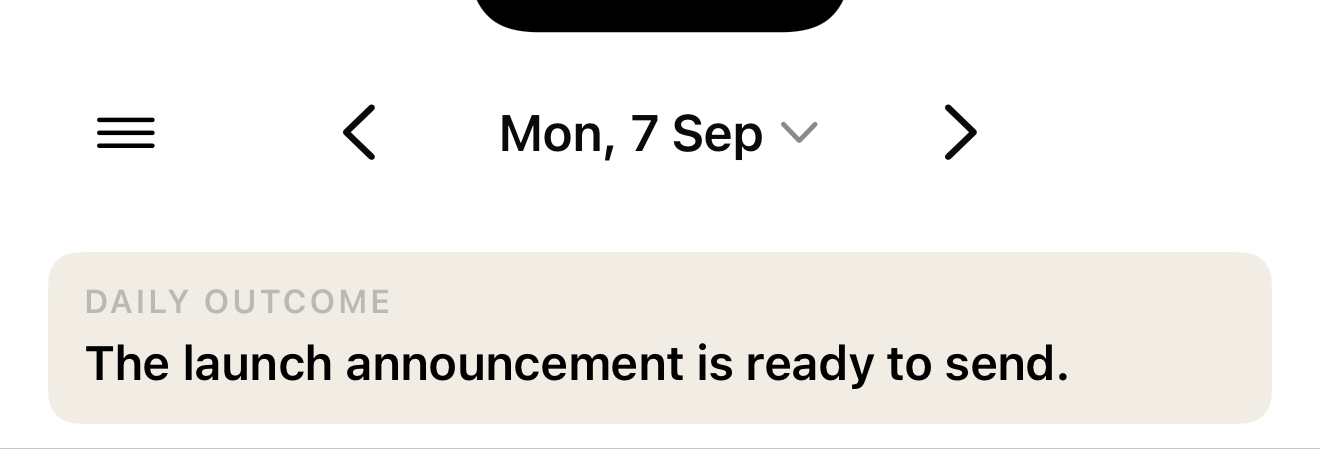
Now try one question instead: what would have to be true by this evening for today to count?
One sentence. Not a list, not a category — a specific outcome. The proposal is with the client. The bug is fixed and shipped. I’ve had the conversation I’ve been avoiding.
That sentence does something a ranked list can’t: it settles arguments. When two things compete for the same hour, you don’t compare them to each other any more. You ask which one serves the sentence. Most of the time the answer is immediate.
The rest doesn’t disappear
The fear is that naming one outcome means abandoning the other eleven things. It doesn’t. They’re still there, still real, and most of them will still happen today — email gets answered, the small stuff gets done, life continues.
What changes is their status. They stop being contenders for your best hours. They become the things you do around the thing that matters, rather than instead of it. Nothing is deleted; the day just gains a spine.
Choosing the sentence
Two failure modes worth avoiding.
Too big: “make progress on the redesign” isn’t an outcome — you can’t tell at 6pm whether it happened. Ask what you’d point at to prove it.
Too safe: if the sentence is something that was going to happen anyway, it isn’t steering anything. The useful version names the thing you’d otherwise let slide.
A good sentence usually feels slightly uncomfortable when you write it, and slightly satisfying when you read it back at the end of the day.
Some days there isn’t one
Some days are genuinely just maintenance — clearing the decks, catching up, being available. Say so, honestly: today is for catching up. That’s a legitimate outcome, and naming it stops you feeling vaguely guilty about a day that was actually fine.
The point was never to be productive every day. It’s to stop letting an unsorted list decide which parts of your life get your attention.
Make My Day starts the day with one sentence, and lets the work that serves it come forward. See how it works.